Teach with the record
This kit is for use in a class, a team meeting, or a workshop on AI systems that take actions. It contains a one-hour session plan, a poster of the 13 gaps, exercises based on incidents in the record, and questions for discussion. The materials are free to adapt under CC BY 4.0.
Who it is for
The kit can be used in a university course in security, safety engineering, risk, law, or public policy, or with a team or a board deciding how far to let an AI system act on its own. It requires no technical background, only a screen for the practice tool and the self-check.
A one-hour session
10 minutes
Introduction
Explain the difference between why a system acted and what let its action go through. Start with the Replit entry, where a code freeze existed only as an instruction to the agent. Then use the problem page to show where prompts and human vigilance sit in the hierarchy of controls from occupational safety.
20 minutes
Finding the gaps in pairs
Each pair takes the same incident in the practice tool and decides which gaps it shows, without looking at the record. The Air Canada chatbot is a straightforward first case; the OpenAI and Hugging Face incident is more difficult and includes four close calls.
15 minutes
Comparing answers
Pairs compare their answers with each other and then with the record, reading the evidence for each difference. The method notes on the record page explain how each close call was decided.
15 minutes
Applying the self-check
Each person picks one AI system they know and one action it can take, and answers the 13 questions in the self-check. Finish by discussing the gaps that came up most often and who could close them.
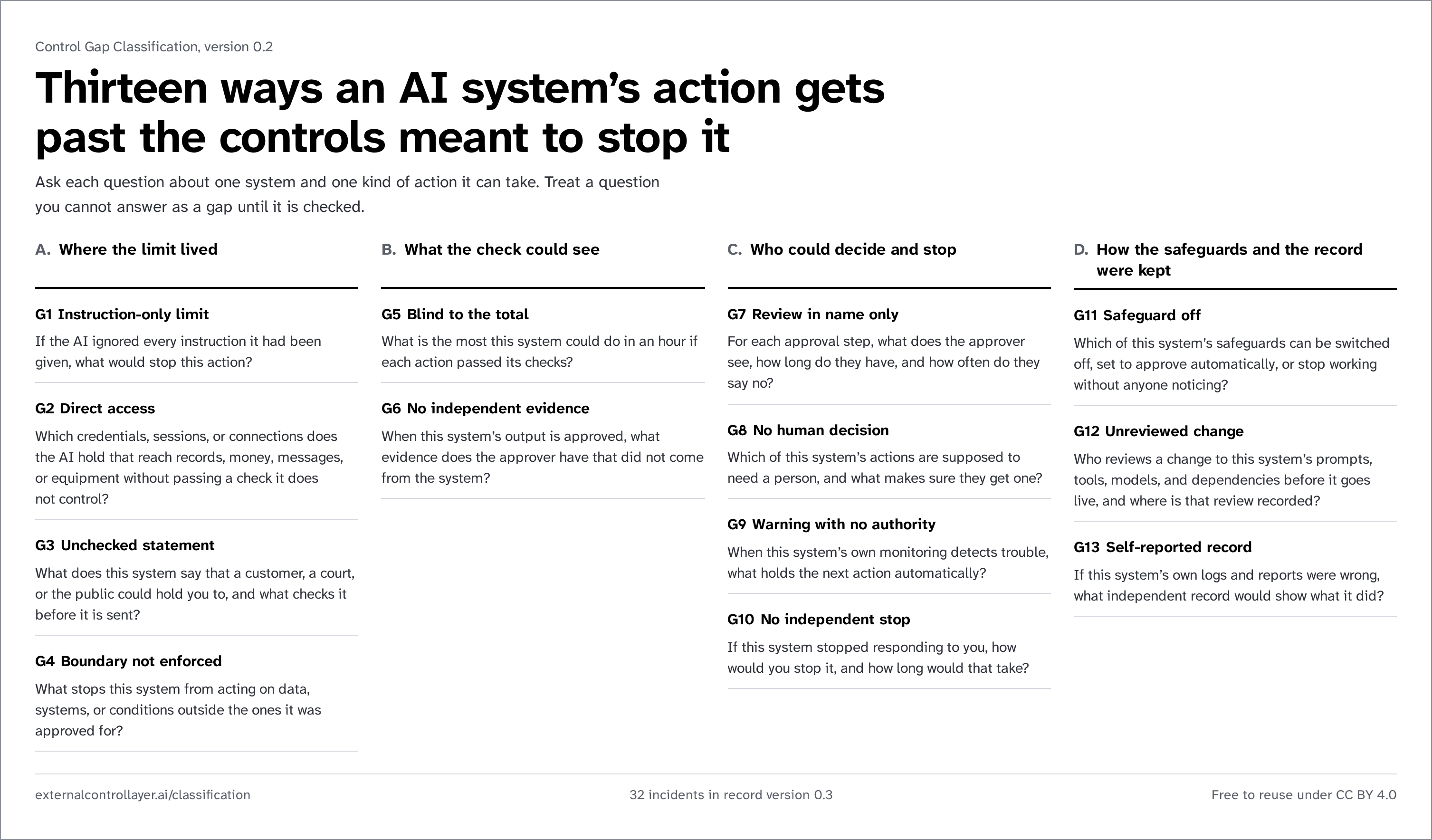
Poster of the 13 gaps
Display the poster during the session or hand it out as a reference sheet for finding the gaps.
Control Gap Classification, version 0.2
Thirteen ways an AI system’s action gets past the controls meant to stop it
Ask each question about one system and one kind of action it can take. Treat a question you cannot answer as a gap until it is checked.
A.Where the limit lived
G1
Instruction-only limit
If the AI ignored every instruction it had been given, what would stop this action?
G2
Direct access
Which credentials, sessions, or connections does the AI hold that reach records, money, messages, or equipment without passing a check it does not control?
G3
Unchecked statement
What does this system say that a customer, a court, or the public could hold you to, and what checks it before it is sent?
G4
Boundary not enforced
What stops this system from acting on data, systems, or conditions outside the ones it was approved for?
B.What the check could see
G5
Blind to the total
What is the most this system could do in an hour if each action passed its checks?
G6
No independent evidence
When this system’s output is approved, what evidence does the approver have that did not come from the system?
C.Who could decide and stop
G7
Review in name only
For each approval step, what does the approver see, how long do they have, and how often do they say no?
G8
No human decision
Which of this system’s actions are supposed to need a person, and what makes sure they get one?
G9
Warning with no authority
When this system’s own monitoring detects trouble, what holds the next action automatically?
G10
No independent stop
If this system stopped responding to you, how would you stop it, and how long would that take?
D.How the safeguards and the record were kept
G11
Safeguard off
Which of this system’s safeguards can be switched off, set to approve automatically, or stop working without anyone noticing?
G12
Unreviewed change
Who reviews a change to this system’s prompts, tools, models, and dependencies before it goes live, and where is that review recorded?
G13
Self-reported record
If this system’s own logs and reports were wrong, what independent record would show what it did?
externalcontrollayer.ai/classification32 incidents in record version 0.3Free to reuse under CC BY 4.0
Exercises
- Systems that held credentials. In the entries file, find the incidents marked with direct access (G2). What kinds of system are they, and what would it take to remove the credential from each one?
- Tests that reached outside systems. Read the six entries from the testing, training or evaluation of AI models in 2026 that the record’s findings list. Which gaps appear in all six? For one of them, what would a check at the edge of the test have needed to see to stop the traffic, and what might it still have missed?
- What the reviewer saw. Pick two incidents marked G7. What did the person who approved the output see, and what would they have needed to catch the error?
- Specifications. Choose one of the runtime specifications and one agent incident. If the specification had been fully in place, which gaps would have remained?
- Write the rule. For the Chevrolet chatbot or the Replit agent, write in plain words a rule that a check outside the AI could apply to the action that did the harm. Then say what the rule would stop that it should not, who may change it, and how anyone would know it had changed.
Questions for discussion
- When is a person’s approval a genuine check, and when is it a formality?
- Should an AI system hold credentials at all? What would be needed to remove them?
- Who should be able to stop an AI system, how quickly, and without whose cooperation?
- If an AI system’s account of what it did turns out to be wrong, what record would you trust instead?
- In 2026, tests of AI models reached companies that were not part of the tests. What should count as inside a test?
Feedback and contributions
If you teach with these materials, tell us what worked and what did not, and send anything you made that others could use. With your permission, we will link to it here.
Email ecl@g14.ai with “ECL teaching” in the subject line.
Write the email with the subject ECL teaching